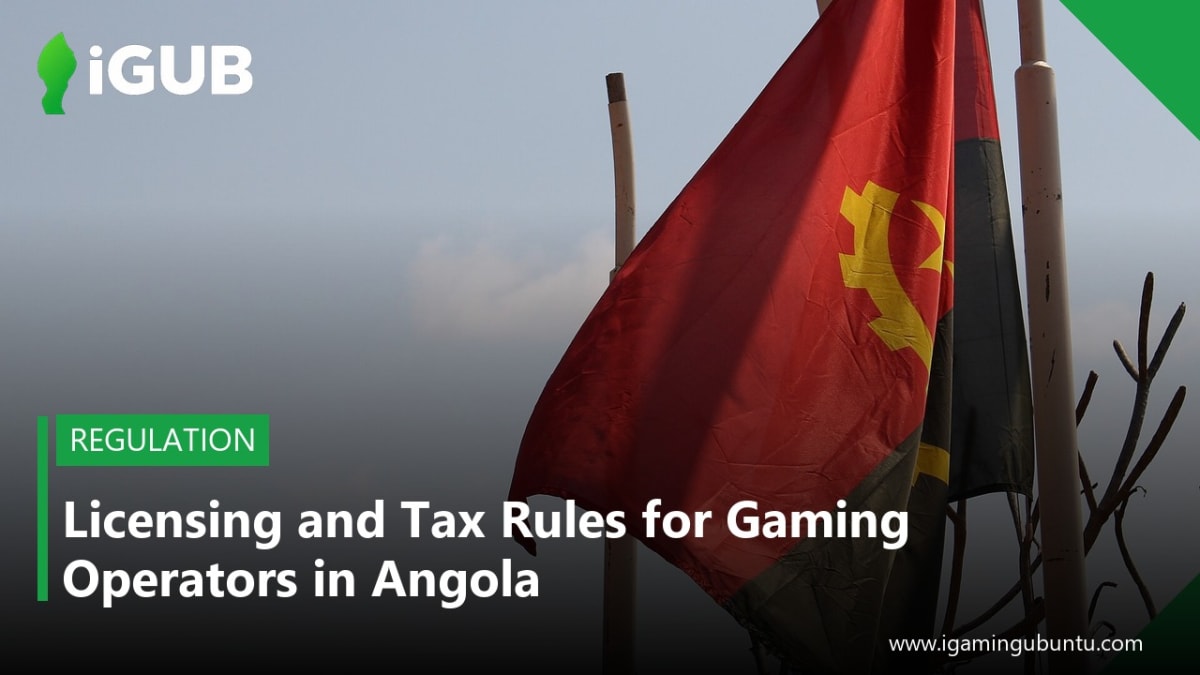

Angola regulates land-based casinos, gaming halls, social games and online gambling under one statute, administered by the Instituto de Supervisão de Jogos (ISJ) under the Ministry of Finance.
The governing law is Law No. 17/24 of 28 October, the Gaming Activity Law, which repealed Law No. 5/16 of 17 May.
Entry is by public tender and concession, not by open registration, so the timing of a market entry depends on the ISJ's tender calendar rather than on when an applicant is ready. This guide sets out what the law covers, how an operator gets a licence, the approvals needed over ownership, and the tax that applies once trading starts.
What the law covers
Law No. 17/24 applies to games of chance run in physical venues and on online platforms anywhere in Angola, and aboard ships and aircraft registered in Angola while operating outside national territory.
- Covered activities: casino table games, slot machines, sports betting, social games and online gambling.
- Minimum age: 18, in venues and online.
- No activity may run without a licence or concession granted by the ISJ.
- Operating without authorisation, or breaching the statute, carries criminal and administrative penalties.
How operators get in
Market access runs through public tenders and concession contracts supervised by the ISJ.
- Applicants must register a commercial company in Angola and show transparent shareholder ownership and financial solvency.
- Online gambling licences are granted to public limited companies. Outside the exclusivity regime, a licence may go to a private legal person governed by Angolan law with a registered office in Angola.
- Licences granted by public tender now run for 10 years, up from 5 under the old law, and can be renewed for the same period. The law runs two regimes, exclusive and non-exclusive, for operating games of chance.
- Operators licensed under the previous law were given 180 days from the entry into force of Law No. 17/24 to bring their corporate and technical arrangements into line with the new rules.
- Law No. 17/24 publishes no universal application or annual fee table. Upfront fees and bank guarantees are set in each tender dossier and concession agreement.
Because fees sit in the tender documents rather than in the statute, figures quoted by licensing agents should be treated as estimates until the dossier is bought and read.
Shareholding approvals
The ISJ vets ownership before any change takes effect. Anyone seeking to acquire a qualifying holding in a gaming operator, directly or indirectly, must apply to the ISJ for prior authorisation. The same applies where a holding rises to reach or pass 20%, 33% or 50% of share capital, or where the operator becomes a subsidiary of the acquirer.
Two points follow for group structures. An intra-group reorganisation can trigger the requirement even where no third party is involved, and authorisation must be in hand before completion rather than filed afterwards.
Gaming tax, corporate tax and withholding tax
Angola charges a sector tax on gaming receipts alongside the general corporate taxes.
| Tax | Rate | Base and rules | Source |
|---|---|---|---|
| Special Gaming Tax (Imposto Especial de Jogos) | 1.1% to 20% | Charged on gross gaming revenue, with the rate set by the form of gambling | PLMJ |
| Withholding tax on prizes | 10% to 15% | Deducted at source from player winnings | PLMJ |
| Corporate income tax (Industrial Tax) | 25% | Charged on net annual taxable profit | PwC Angola |
| Dividend withholding tax | 10% | Investment Income Tax withheld on dividends and repatriated profits | PwC Angola |
| VAT | 14% | Standard rate on taxable supplies | PwC Angola |
The Special Gaming Tax takes the place of general turnover taxes on core gaming receipts. Corporate income tax still applies to net corporate profit after allowable deductions, so an operator should model both rather than assuming the sector tax settles everything.
Promotions, monitoring and compliance
Three obligations shape day-to-day compliance.
- Gaming terminals must be connected to central regulatory monitoring systems.
- Anti-money laundering controls and player data rules apply alongside the gaming licence.
- Article 51(3) of Law No. 17/24 requires prior ISJ authorisation before launching promotional raffles, prize draws and random combinations used for promotional or advertising purposes. Prizes awarded in those campaigns fall under the Special Gaming Tax, withheld at source by the promoter.
The promotional rule catches marketing teams more often than compliance teams, because a prize draw run by an agency on an operator's behalf still needs the authorisation. A campaign that launches before approval becomes an administrative offence rather than a late filing.
What to settle before applying
- Decide whether the business is applying under the exclusive or the non-exclusive regime, since the two are licensed differently.
- Set up the Angolan company in the right legal form for the licence being sought.
- Map every direct and indirect holding against the 20%, 33% and 50% thresholds, including holdings created by a future funding round.
- Buy the tender dossier for the fee schedule and guarantee requirements instead of budgeting from published estimates.
- Build the promotional approval step into the marketing calendar, with time for the ISJ to respond.
- Model the Special Gaming Tax and corporate income tax separately.
Angola rewards operators that treat the tender timetable and the ownership approvals as part of the product plan. Both sit outside the operator's control, and both take longer than the technical build.
Operators weighing Southern and West African entry can compare Angola's concession model with:
Last reviewed: 18 November 2026. This article is for information, not legal or tax advice. Gambling is for adults only (18+). Image: vanessa lollipop, CC BY-SA 2.0, via Wikimedia Commons.